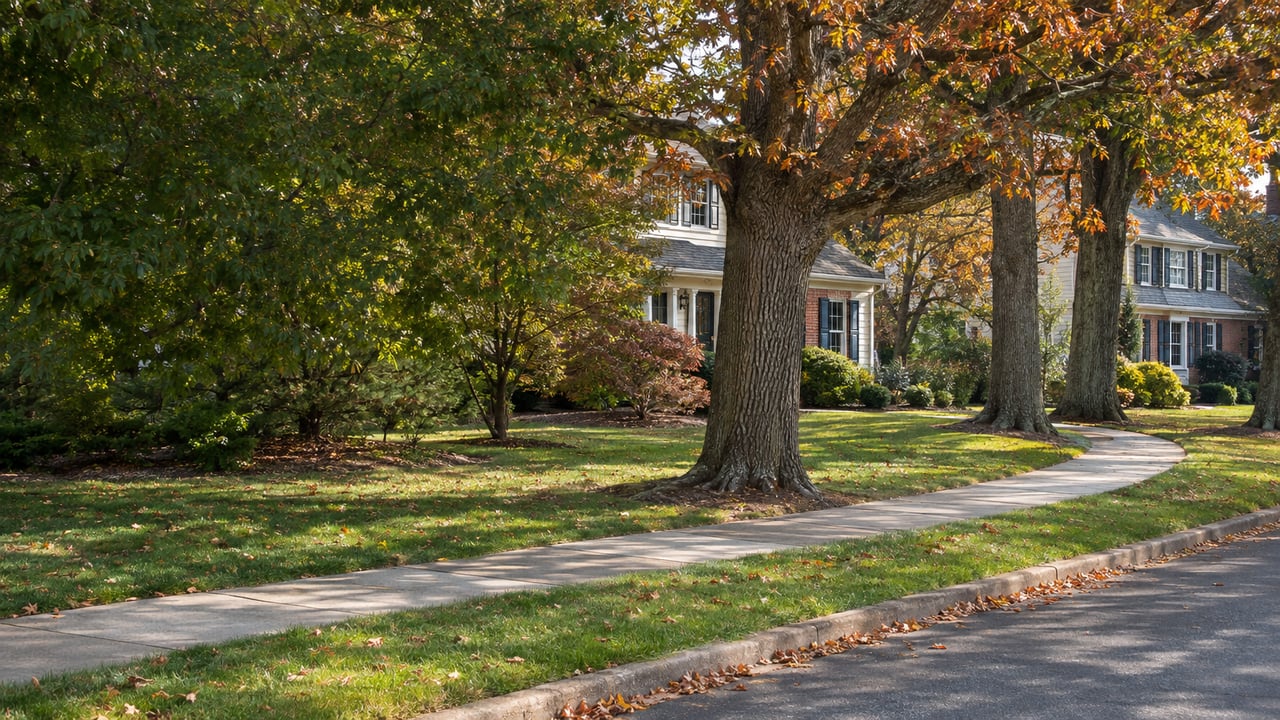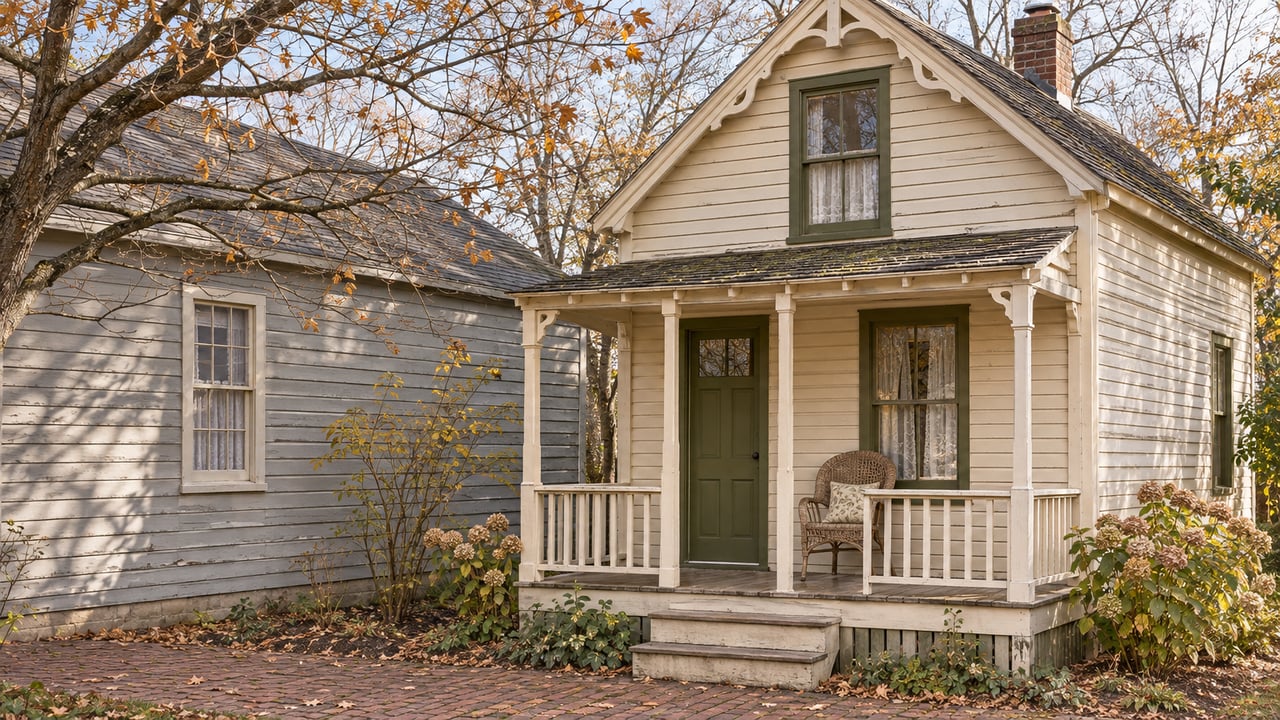
The smallest house in Pitman Grove sits at 16 12th Avenue. It has one floor, two rooms, a one-bay hip-roof porch and a small front gable, according to the borough's National Register nomination. A few blocks north, the same nomination describes houses like 23 Webb Avenue: two full stories on an L-shaped plan, with a rounded porch at the inner corner. Both houses are in Pitman, and both count toward the same borough-wide sales figure.
That figure is where most buyers start. The New Jersey Division of Taxation's 2025 Average Residential Statistics list an average sale price of $357,107 for Pitman across 107 sales in that year's table. The same table shows $374,469 for Mantua Township and $572,213 for Harrison Township. Next to those numbers, Pitman looks like a slightly cheaper Mantua. Pitman actually began as two different kinds of housing, laid out for two different purposes. The average blends them, so comparing a Grove cottage with a house outside the wheel means comparing two different purchases.
A Town Drawn Around a Preaching Ground
Pitman was planned before it was a town. The Borough of Pitman's history says the New Jersey Camp Meeting Association bought land from the Jessup family, built an auditorium at the center and ran a circular street around it, with twelve streets radiating out like the spokes of a wheel. The first camp meeting was held in August 1871, and the 600 tents at that meeting were the only housing. The Association began selling lots in 1873, and by 1890 the Grove had more than 400 permanent homes.
The lots were sized for tents. A 2021 article in NJS: An Interdisciplinary Journal describes 20-by-30-foot lots between the avenues of the wagon wheel. Surveyors later laid out 30-by-40-foot lots beyond the core, and the Association divided outlying land into half-acre lots as the grounds grew to 230 acres. The same article notes that the plan went in quickly, which left uneven spacing between avenues and irregular lot sizes inside the wheel. Over the years, many of the first small cottages were replaced with larger two-story buildings.
Those three lot sizes still mark the boundaries between Pitman's housing pockets. Inside the wheel, many cottages are one and a half stories, with a knee wall on the second floor. Outside the wheel, the nomination describes late-19th and early-20th-century frame houses that are generally larger, and about 75 percent of them have two full stories. About 70 percent of those two-story houses follow the L-shaped Webb Avenue plan, and most of the rest are double houses like 224 West Avenue, which has two front gables. Farther out, the nomination describes an early-20th-century suburb north of Holly Avenue with several mid-century tract houses.
Cottages Built for Summer, Lived In Year-Round
Inside the wheel, the houses were built for a season that no longer sets the calendar. The Borough's historic preservation guidelines say the cottages were meant for summer occupancy and were not designed for year-round use. Over time, more of them were lived in twelve months a year, and a small business district grew up on what is now Broadway to serve those residents.
The same guidelines describe the Grove's dwellings as small, with little yard around them, on a street pattern designed for pedestrians that was inadequate for vehicles. In 1971, the Borough bought the Camp Meeting Association's lands and homes for $100,000 to provide good-quality, lower-income housing, along with parking and commercial space. Since 1987, the state Department of Community Affairs has put more than $1,000,000 toward homeowner rehabilitation in the area.
For a buyer today, that history comes down to three practical questions about any Grove house: how big it is, where the car goes, and what's under the siding.
Where the Car Goes
Parking is the first thing to ask about any listing inside the wheel. The Courier-Post's June 2023 report on a proposed duplex on East Avenue described a 1,644-square-foot property with no on-site parking, whose tenants would use the existing Grove parking lots. The paper reported that the board focused on the existing parking shortage in the Grove and neighboring Uptown. Board Chairman Nichola Aspras agreed that spaces are in short supply and called it "a good problem now," because "there was a point in time when the borough was empty."
A house on a larger lot outside the wheel and a cottage that relies on nearby shared lots can be listed at similar prices and still make for very different days. Before you compare the two, find out where the car goes, whether there's room for a second one, and how far you'd carry groceries.
What's Under the Siding
Grove cottages wear more than a century of changes. When the Grove was nominated to the National Register, about 85 percent of the houses in the wheel had been re-sided, almost all of it between about 1930 and the 1940s. Roughly 20 percent of that re-siding was asbestos, about 30 percent was asphalt made to look like brick, and about half was asphalt shingle. The original cottages were mostly finished in narrow vertical beaded boarding. The double house at 224 West Avenue still has it inside and out, but many others were later covered with shingles or clapboard. The same record found that about 80 percent of the original porches survived, along with most of the original window openings.
Outside the wheel, about half of the larger houses still had their original clapboard or wainscoting at the time of that survey. Two houses with similar porches and similar paint can have very different materials under the paint, and a 1940s asbestos shingle is a different conversation from original clapboard. Ask about the siding at your home inspection, and if you plan to rebuild rather than refresh, have the foundation and framing checked by the right professionals before you commit.
How the County Market Reads This Fall
Pitman sells inside a Gloucester County market that slowed a little this fall. The NJ REALTORS Local Market Update for October 2026, current as of November 9, 2026, shows the county's single-family median sale price at $395,000 for October, up 1.3 percent from October 2025. Over the same comparison, days on market rose from 28 to 33, inventory grew from 524 to 595 homes, and months of supply went from 2.4 to 2.9. Sellers received 100.4 percent of list price in October 2026, down from 102.0 percent a year earlier. Year to date through October 2026, the county's single-family median was $400,000.
For a Pitman buyer, the extra days matter more than the price. A market with time for a second showing also has time to sort out parking, look closely at an older house's siding and structure, and get a contractor's opinion before writing an offer. That kind of homework was harder to fit in a year earlier, when homes sold for more than their asking price in a few weeks.
The small number of sales also explains why the borough average says little about any one house. Pitman's $357,107 figure from the 2025 state table covers 107 sales across about 2,985 residential line items. With so few sales, a year with more two-story houses from Webb Avenue or more one-and-a-half-story cottages from the wheel can move the average while the price of each kind of house stays put. Compare a Grove cottage with recent Grove cottage sales, and a two-story frame house with other two-story frame houses. Weigh either against Mantua or Mullica Hill only after that.
What Each Pocket Gives You on a Saturday
A Grove cottage gives up space in exchange for a short walk. The guidelines tie the business district on Broadway to the Grove's year-round residents, and the wheel still sits a short walk from the auditorium and Uptown. The Grove's streets are also planted with large oak trees, which the nomination says soften the transition from one house to the next. Our earlier look at what's pouring and plating in Uptown Pitman covers where that walk ends up, and our Pitman neighborhood page has more about the borough.
A two-story house outside the wheel usually gives you more rooms, more yard and an easier answer to the parking question, with a slightly longer walk to Broadway.
If a Grove cottage or a house on Webb Avenue has caught your eye, The Pat Settar Team would be glad to walk through it with you, from where the car goes to what's under the siding. Reach out whenever you're ready to talk about a Pitman address.